Why mindful eating feels harder than expected
You sit down with the intention to “be mindful,” and somehow the meal is over before you’ve really tasted it. The plate looks normal, nothing felt dramatic, but a few minutes later you’re already scanning for something else—more crunchy, more sweet, more “finishing.” That mismatch can feel like a personal failure, even when you were trying.
What’s often happening is simpler: busy eating trains your attention to lock onto whatever is loudest—email pings, traffic, deadlines, a video—while flavor and texture become background noise. When that happens, the brain leans on easy external cues (how big the portion was, what time it is, what you usually do) to decide when the eating “should” be done, instead of using taste and growing satisfaction as the guide.
Fullness can also lag behind speed. If you eat quickly or under stress, it may feel like nothing changes until suddenly you’re uncomfortably full—or oddly unsatisfied. In that light, mindful eating isn’t a moral skill. It’s an attention skill that gets harder precisely when life is loud.
Hunger, appetite, and cravings pull differently
Halfway through a busy afternoon, you might notice something odd: your stomach isn’t exactly empty, yet the idea of something salty or sweet suddenly feels urgent. That’s often where people lump everything into “I’m hungry,” when it’s actually a few different pulls happening at once—and they don’t respond to the same fix.
Hunger tends to feel more like a physical need that builds steadily, especially if it’s been hours since you ate. Appetite is often more “this sounds good right now,” shaped by smell, mood, and what’s nearby. Cravings can be narrower and louder—specific texture, temperature, or flavor—sometimes spiking when you’ve been stressed, under-slept, or eating on the run. In those moments, grabbing more food can quiet the craving briefly, but it may not create the settled, satisfied feeling you expected.
When eating happens fast or distracted, these signals blur together. You can end up chasing the missing “click” of satisfaction with extras and seconds, even if the body’s basic fuel needs were already met.
The first bite effect and satisfaction curve
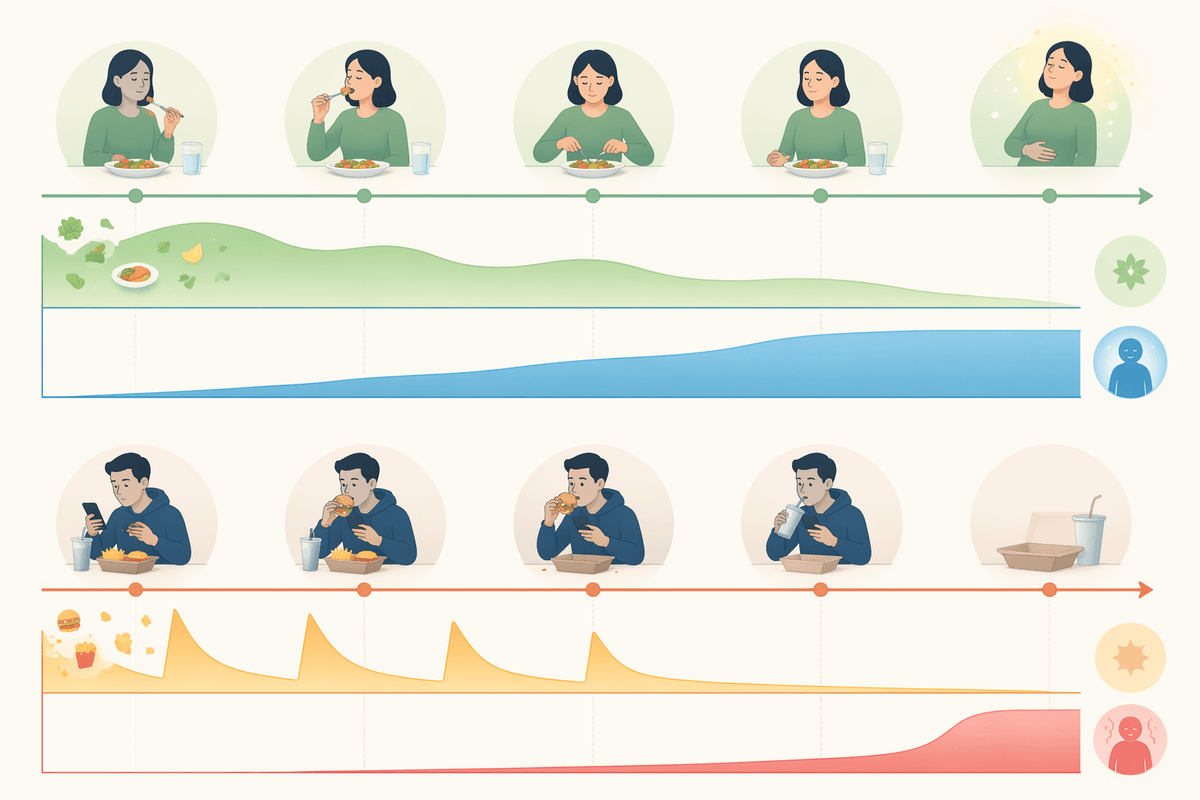
The first few bites are often the loudest. You finally taste the meal—warm, salty, crunchy—and for a moment it feels like exactly what you needed. Then, without noticing when it happens, the flavor starts to fade into the background, especially if your eyes are back on a screen or your mind is already on the next task.
This is the “first bite” effect in real life: early bites deliver a bigger hit of novelty and contrast, and later bites give a smaller return. Satisfaction tends to rise quickly, then level off. If you’re eating fast, you may blow past that leveling-off point before your brain has time to register, so it can feel like you need more food to get the same impact.
That’s why seconds sometimes happen when the plate was fine. It may not be hunger so much as trying to recapture the intensity of the beginning—using quantity to solve an attention problem that already shifted elsewhere.
Reasonable ‘healthy swaps’ that backfire emotionally
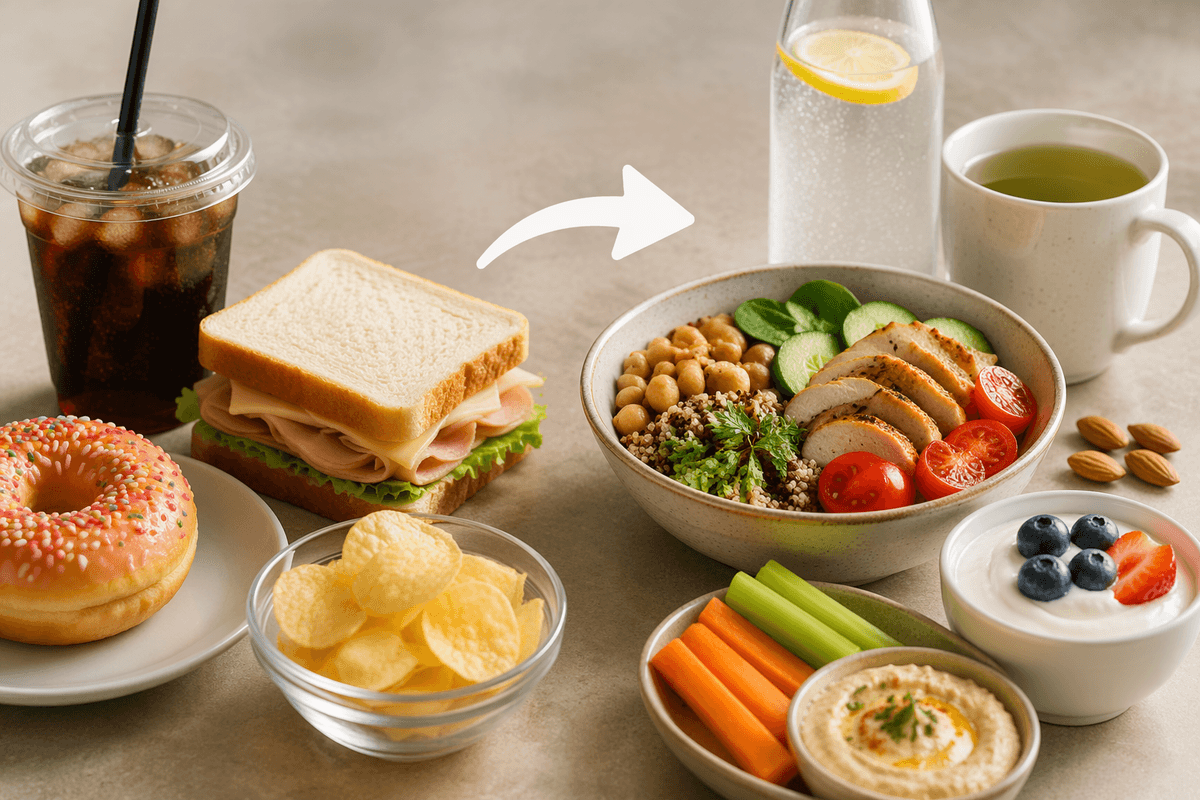
You swap the usual lunch for the “better” version—salad instead of a sandwich, yogurt instead of ice cream—and it looks responsible on paper. But halfway through, there’s a low-grade irritation: you’re still thinking about food, still wanting something more dense, more warm, more finished. That can be confusing because you did what you were “supposed” to do.
Often the swap changed more than calories. It changed texture, temperature, and satisfaction speed. Crunchy greens disappear fast; a protein bar is technically filling but can feel emotionally flat; a low-fat version may lose the mouthfeel that signals “this counts as a real treat.” When the sensory payoff is thinner, attention drifts sooner, and the brain keeps scanning for the missing note.
Then the backfire shows up as grazing later—not because you’re weak, but because the meal didn’t land. In a busy day, “healthy” that doesn’t satisfy can quietly train you to keep looking.
How distractions quietly rewrite portion and pace
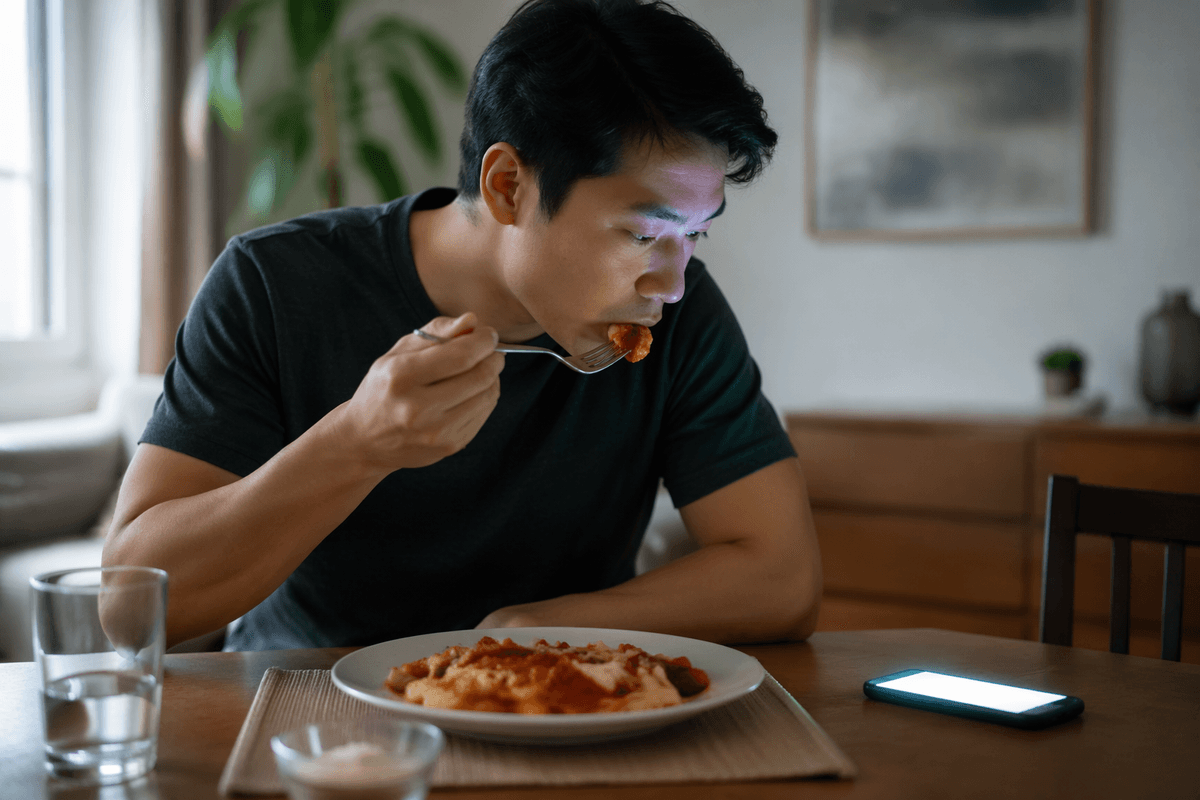
It’s easy to look down and realize you’re already at the bottom of the container, with only a vague memory of chewing. The food didn’t taste bad—you just didn’t spend much time with it. And because your attention was parked on a screen, a meeting, or the road, the meal can feel strangely “un-counted,” like it never really happened.
Distraction changes what your brain uses as a stop signal. Instead of tracking flavor fading, texture slowing you down, and satisfaction building, it leans on whatever is obvious: the end of a bag, the size of a bowl, the next calendar alert. Pace tends to speed up without friction, so the body’s fullness feedback arrives late, sometimes after you’ve already out-eaten the point where the meal would have felt settled.
That’s why mindless seconds and desk-snacks often show up as a timing problem, not a willpower problem. When the meal is absorbed like background noise, the brain keeps “checking” for completion later—usually with something quick, crunchy, or sweet.
Simple awareness anchors you can repeat anywhere
You notice it most when you stand up: the meeting’s still in your ears, the screen glow follows you, and yet your mouth is already looking for “one more thing.” It can feel like your appetite turned on after lunch, but often it’s that lunch never got fully registered because your attention stayed split.
In practice, the most repeatable anchors are small, not precious. A quick pause before the first bite to name what you’re expecting (warm, crunchy, sweet, “something real”). A mid-meal check for the point where flavor starts flattening. And a last-bite question: “Does this taste better, the same, or worse than bite three?” If it’s worse, continuing may be habit more than hunger.
These cues aren’t always clean—stress can blur them, and some days you’ll forget entirely. But over time, they shift the brain back toward taste and satisfaction as the “stop” signal, instead of the bottom of the container.
Fullness signals vary with stress and sleep
Some days you finish a normal lunch and still feel oddly hollow—like your stomach is full but your mind is waiting for a closing scene. Other days, a few bites can tip into “too much” fast. People often read that as inconsistency or a lack of control, when it’s often the context doing the steering.
Stress can push the body into a more driven, get-it-done mode. In that state, eating tends to speed up, chewing gets shallow, and the subtle “this is enough” signal can arrive late or feel muted. You may also notice more reaching for sharp, crunchy, or sweet foods—not because you’re truly empty, but because your system is looking for quick contrast that cuts through the mental noise.
When you’re under-slept, fullness can feel less reliable: you can eat a reasonable portion and still want more, or keep snacking because nothing quite lands. If that pattern shows up after short nights or high-pressure days, it’s useful feedback—not proof you “blew it.”
Turning awareness into choices without perfectionism
The moment you realize you were “trying to be aware” and still ate half the meal on autopilot, the mind often jumps to rules: no phone, smaller portions, more discipline. But rules can turn the meal into a test, and tests make people rush or second-guess—two things that flatten satisfaction fast.
A more workable shift is treating the signals as information. If you keep wanting something after you’ve eaten, it may be that the meal ended without a clear “finish” in your attention—too fast, too distracted, not satisfying enough in texture or warmth. If you notice that pattern, the choice doesn’t have to be perfect; it can be small: slow the next few bites, or decide whether what you want is actually contrast (crunch, sweet, cold) rather than more volume.
Some days the best you can do is catch it late. Even that counts. The win is noticing what pulled you away, so the next meal has a slightly better chance to land.