Why trying to sleep can keep you awake
Your eyes feel heavy, but the moment your head hits the pillow your mind starts “checking” whether sleep is happening yet. People often describe it as a quiet switch flipping from drowsy to alert—like you’ve missed your chance. That’s not just frustration. It’s a real shift in effort and attention that your body can interpret as a reason to stay on guard.
Trying hard to sleep usually brings a subtle kind of problem-solving online: you monitor your breathing, count hours, replay tomorrow, adjust the covers, reach for the phone “just for a minute.” In some situations, that extra monitoring nudges your nervous system toward wakefulness, raising heat, heart rate, and mental activity just enough that sleepiness can’t settle.
Over time, bedtime can start to mean “work at sleeping” instead of “drift off.” If the pattern continues, it may feel like you’re tired all day but strangely activated at night—less about willpower, more about the brain learning that the bed is where you think, plan, and evaluate.
A stable wake time anchors sleepiness later
The next morning can feel like the first small mistake: you finally fell asleep late, so sleeping in seems like the only way to “pay back” the night. But that extra hour or two often changes what happens twelve to sixteen hours later. People are surprised when they’re exhausted at 3 p.m., then oddly awake again at 11 p.m., as if their sleepiness showed up at the wrong appointment.
A steady wake time tends to act like a daily anchor for your body clock. When it shifts later, your whole timing can slide with it—hunger, alertness, and the window when sleepiness feels easy. You can still feel tired while your brain’s “stay awake” signals are running high, especially if the day includes bright screens, stress, or a nap.
In real life it’s rarely perfect—weekends, kids, deadlines. Still, noticing how often “sleeping in to fix it” leads to another late night can be the first clue that timing, not effort, is driving the pattern.
Light exposure quietly shifts your internal clock
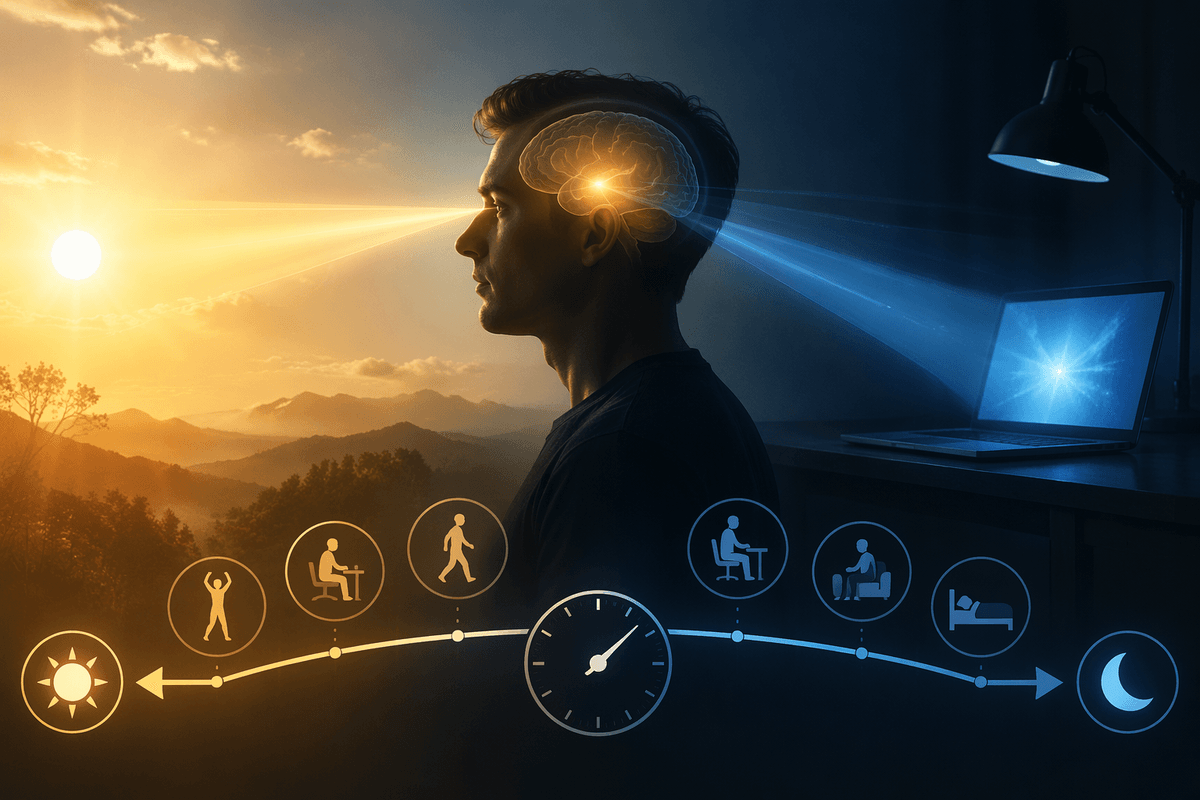
You might not notice it until you walk into a dim bedroom and feel suddenly more awake than you did on the couch. The room is quieter, but your eyes just got a dose of light—overhead bulbs, bathroom mirror lighting, the phone held close—and your brain treats that as “still daytime.” Then you’re left wondering why your body feels tired while your system won’t fully downshift.
Light is one of the strongest timing signals your internal clock pays attention to. Brighter light earlier in the day tends to pull your rhythm earlier, while bright light late in the evening can nudge it later—especially the short-wavelength, screen-heavy kind that keeps the visual system engaged. The frustrating part is the delay: tonight’s light choices can show up as tomorrow night’s “tired but wired,” which makes the cause easy to miss.
In practice, it’s rarely all-or-nothing. A single late movie night might not matter, but repeated bright evenings plus darker mornings can slowly shift the window when sleep feels effortless.
Wind-down cues reduce mental carryover at night
It often starts with something small: you finally close the laptop, and your body feels spent, but your mind keeps running as if it’s still answering messages. People assume that once the work stops, the brain should “get the memo.” Yet if the last hour of the night is filled with decisions, bright attention, and quick hits of novelty from a screen, it can feel like you brought the day into bed with you.
Wind-down cues work less like a magic trick and more like a handoff. When the pre-sleep window is predictable—same general order of low-stakes actions, similar light levels, fewer inputs that demand a response—the nervous system has an easier time shifting from scanning and solving to settling. When it’s inconsistent, the brain may stay in a “keep monitoring” mode, because it hasn’t learned what signals actually mean the day is over.
For some people, “quiet time” is exactly when worries finally get room to surface, so the routine becomes a stage for mental catch-up. If that pattern continues, it may help to notice which parts of your evening keep you oriented outward (news, email, scrolling) versus inward (shower, stretching, a familiar show), because the difference often shows up as how much thinking follows you into the dark.
Caffeine, alcohol, and late meals distort drowsiness
It can feel unfair: you’re yawning after dinner, then you have a coffee to power through a few tasks and suddenly midnight arrives with your eyes open. What confuses people is how delayed the effect can be. Caffeine doesn’t just “wake you up” in the moment—it blocks the build-up of sleep pressure, so the tiredness you expected at bedtime can get muted or arrive later than usual.
Alcohol can create a different kind of trap. A drink may take the edge off and make you feel sleepier at first, but as it wears off the body often shifts toward lighter, more fragmented sleep. Some people interpret that as “I’m not tired enough,” when it’s really that the second half of the night becomes easier to interrupt.
Late meals tend to blur the signal too. A heavy or spicy dinner can keep digestion and temperature regulation busier into the night, so the body is tired but not fully settling. When this pattern repeats, bedtime starts to feel inconsistent—not because you’re doing it wrong, but because your drowsiness is being edited by timing.
Your bed can become a cue for wakefulness

Sometimes the giveaway is how quickly your eyes pop open when you slide under the covers. You were nodding off on the couch, then the bed feels like a place to “get this right.” If you’ve spent a few nights tossing, checking the clock, or reaching for the phone, the mattress can start to carry a quiet association with effort and evaluation rather than drifting.
In that pattern, the body learns by repetition: same space, same posture, same thoughts, same small jolts of alertness. The brain doesn’t separate “I’m exhausted” from “I’m working on sleep” very well—it responds to the cue it’s seen most often. Even harmless habits like reading email, watching clips, or replaying conversations in bed can strengthen the link between lying down and gearing up.
The more you notice it, the more tempting it is to test yourself—“Am I sleepy yet?”—which adds another layer of monitoring. Over time, the bed can become less of a signal for sleepiness and more like a prompt to stay aware, especially on nights you feel behind.
When habits help, and when deeper issues linger
Some nights the changes “work,” but not the way you expect. You keep the wake time steady, cut back the late coffee, dim the lights—and still find yourself staring at the ceiling. That’s often when people assume they’ve failed, when it may simply mean you’ve removed a few loud sleep-disruptors and uncovered what was quieter underneath: a nervous system that stays on duty once the house goes dark.
In practice, habit shifts tend to help most when the pattern is mostly timing and conditioning—late light, irregular mornings, the bed becoming a place for checking and fixing. They help less when the mind is using bedtime as the first uninterrupted moment to process stress, grief, conflict, or ongoing uncertainty. In those cases, you can feel exhausted while your body keeps producing “keep watching” signals, because tomorrow still feels unresolved.
If the same awake stretch keeps repeating for weeks despite consistent timing and simpler evenings, that repetition itself is information. It may be less about finding the perfect routine and more about noticing what your nights are reliably trying to hold—thoughts, sensations, or worries that don’t respond to a darker room.