When dinner out keeps blowing the budget
It usually starts as a “normal” weeknight plan, then the receipt lands and the number doesn’t match the story you told yourself on the way there. Two entrées that looked reasonable, one round of drinks to be social, a shared starter because it felt awkward not to, then tax, a kitchen fee, and a tip calculated on top of everything. The gap isn’t huge once, but it’s big enough to make the month feel slippery, especially when dinners out are the default way to see friends or decompress after work.
The fastest way to understand what’s happening is to stop treating the menu price as the cost. In practice, the biggest drivers are usually add-ons (apps, sides, dessert), and the “stacking” of percentage-based charges. A $60 pre-tax meal can quietly become $85–$95 after two drinks, a 3–5% service charge, 8–10% tax, and a 18–20% tip. That’s not a moral failure or a discipline issue; it’s the math of compounding extras.
Once you see which line items do the damage, the trade-offs get clearer: keep the place but change the pattern (fewer drinks, fewer shared starters), keep the pattern but change the timing (happy hour, lunch), or keep the “full experience” but do it less often. The constraint is that you can’t optimize all three at once—frequency, vibe, and total spend—so the goal is picking which one matters most for this month’s budget.
Pick the right time, not just the place

The easiest win usually isn’t a different restaurant; it’s a different clock setting. The same group, the same neighborhood, even the same menu can price out two completely different ways depending on whether it’s a peak dinner slot or a slower window the restaurant is actively trying to fill. That matters because the “compounding extras” don’t just come from what’s ordered—they come from how long the night stretches. When dinner becomes a two-hour hang, the second round starts to feel inevitable, and the bill stops behaving like a plan.
Happy hour is the obvious lever, but it’s only useful if it changes what you’d otherwise do. If a $9–$11 drink becomes $6–$7 and you still have two each, you saved something; if the discount makes a third drink feel “basically free,” you gave it back. The cleaner version is time-boxing: arrive early, do one discounted drink or shared bite, then shift to entrées (or go home) before the table settles into “let’s keep this going.” The constraint is timing—early windows can clash with commutes, workouts, or childcare pickup.
Lunch and late-afternoon “brunch-for-dinner” hours often beat dinner on value without feeling like a downgrade. Portions can be similar, but the pricing is less ambitious, and fewer people treat it as an all-in, multi-course occasion. If your goal is social time more than a big meal, moving one meet-up per week to lunch can cut the per-person total meaningfully while keeping frequency intact—just with a different rhythm and a smaller chance of the night snowballing.
Control the “extras” before they control you
Once the timing is working for you, the next leak is the stuff that feels optional in theory and inevitable in the moment. Drinks, apps, sides, dessert, “just sparkling,” the extra sauce—none of it is outrageous alone. The friction is that they arrive early, set the tone, and then every later choice is made in a more generous mood, with a higher running total and less willingness to be the person who “ends it.”
The cleanest control is deciding your extras before you sit down. A simple cap (one drink each, or one shared starter, not both) works because it’s a binary rule that’s easy to remember mid-conversation. The constraint is social pressure: in some groups, matching the pace feels like the cost of admission.
It also helps to notice which extras trigger percentage stacking. A $14 cocktail isn’t just $14; it’s $14 plus tax, then tip on top, and sometimes a service fee in between. If you’re trying to keep a $70 night from becoming a $95 night, the highest-leverage move is cutting one or two of those “pre-entree” lines, not trimming a few dollars off the main course. That’s the difference between feeling deprived and simply keeping the bill from snowballing.
Order for value without feeling cheap
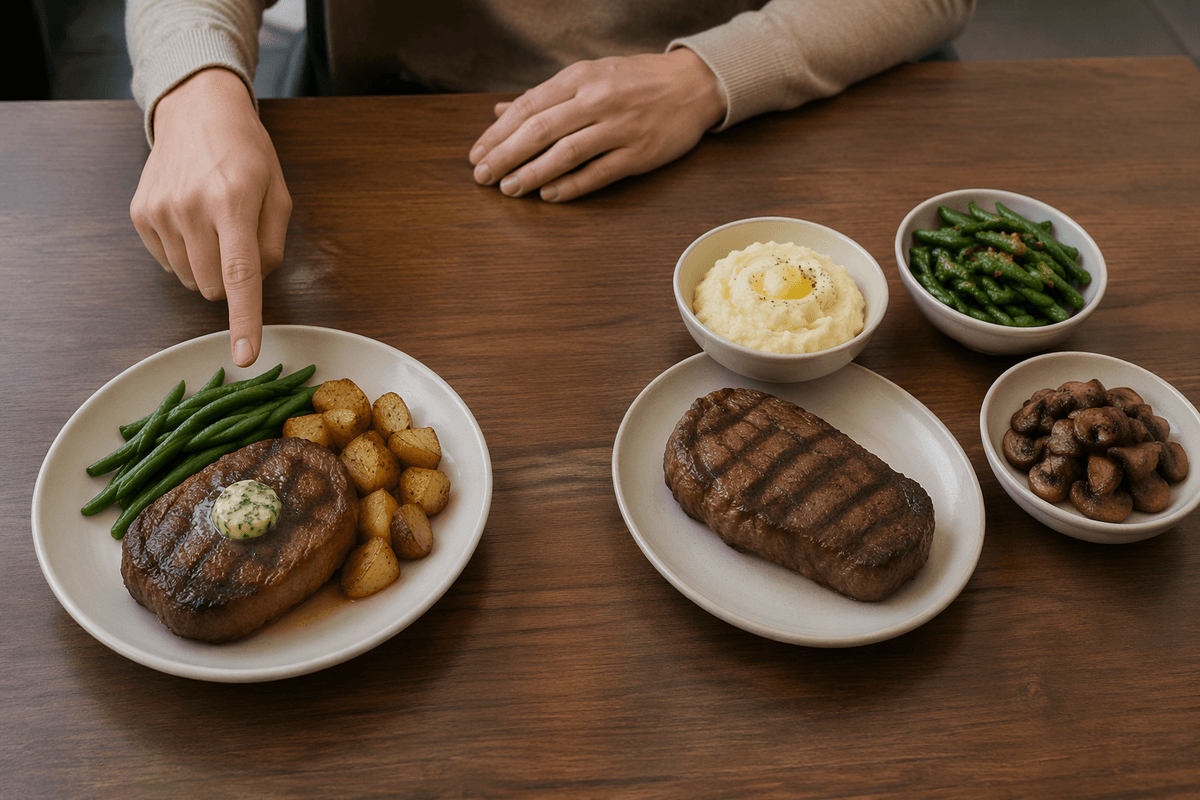
By the time entrées are on the table, the bill has usually already taken its shape. That’s why the “value” decision here isn’t about hunting for the absolute cheapest item; it’s about choosing the part of the meal that will actually feel like the meal. The constraint is emotional as much as financial: if the order reads like a sacrifice, people compensate later with a last-minute dessert or another round, and the savings evaporate.
A reliable pattern is to anchor on one satisfying main and let everything else be supporting cast. Often that means picking the dish that has built-in completeness (a bowl with protein, veg, and starch; a sandwich with a side included; a pasta that doesn’t require add-ons) instead of an entrée that needs $6 sides to feel finished. If two entrées are close in price, the better value is usually the one that keeps you from ordering “just one more thing” after.
Splitting can work, but only when it reduces total line items. Sharing a larger plate plus one extra side is usually cheaper than two mid-priced entrées plus a shared app, because it cuts an entire entrée (and its tax/tip). The friction is timing and appetite: if one person ends up still hungry, you’re back to ordering late add-ons at full price, and the night stops being a plan.
What tends to feel least “cheap” in practice is swapping status signals, not deleting them. If the group expects something “fun,” making it a single standout item (one good appetizer, or one specialty drink) keeps the experience intact while protecting the receipt from becoming a multi-course default.
The frugal move that can backfire
There’s a specific “frugal” play that looks clean on paper and still manages to inflate the final number: splitting something and then chasing the missing satisfaction with late adds. It usually shows up as one entrée for two, plus a side “so it’s enough,” then a second side because it’s not, then an impulse dessert because neither person feels like they actually ate dinner. The constraint is timing—those add-ons hit when you’re already settled, the server is offering options, and it’s harder to course-correct without making it awkward.
The same thing happens with the ultra-light order. A salad-as-a-meal can be a win if it’s genuinely filling, but when it isn’t, the gap gets patched with bread, fries, a snack later, or a second stop somewhere else. That’s not just extra money; it breaks the expectation that “we went out, so we’re done.” If the goal is a lower total without the rebound spending, the better test is simple: will this order prevent a second round of purchases tonight?
If splitting is the move, treat it like a complete plan: one substantial shared main, one deliberate supporting item, and no “we’ll see.” Otherwise the savings get eaten by the exact line items that stack tax, fees, and tip the fastest.
Turning these habits into a repeatable routine
After a few weeks, the question stops being “What should we order?” and becomes “What’s our default?” The routine that held up best in my own tracking was simple: pick the night type before you leave—either a “full experience” dinner once, or two lower-key meals that stay inside a hard per-person cap. The constraint is scheduling; if you decide in the car, you’ll spend like it’s an occasion.
Make it measurable without turning it into homework. Save two recent receipts, circle the two biggest drivers (usually drinks and add-ons), then set one standing rule for the next month: one paid drink max, or one shared starter max, and a time-box (like 75–90 minutes). If the bill still surprises you, it’s a signal to change frequency, not just menu choices.